Yes, a Hyderabad clinic can let an AI chat assistant take appointment bookings on WhatsApp without putting patient privacy at risk, as long as the bot books slots and stays away from medical details. Ask for clear consent before you message anyone, keep symptoms and reports out of the chat, and always offer a quick route to a real person. India’s data protection rules are being phased in right now, so it’s cheaper to set this up properly today than to rebuild it next year.
Walk into almost any clinic in Hyderabad around 10 in the morning and you’ll see the same thing. One receptionist, two ringing phones, a queue at the counter and a WhatsApp chat with forty unread messages, half of them asking “Doctor available today?” It’s no surprise that so many clinic owners are now being pitched AI chatbots that promise to answer patients round the clock.
Some of those tools are genuinely useful. A few are a privacy problem waiting to happen. This is how we’d approach it if it were our own clinic.
Why patients would rather book on WhatsApp
Calling a clinic is annoying. You get put on hold, the line drops, or the person who answers has to check with the doctor and call you back. On WhatsApp, the patient can ask at 11 at night, pick a time between office meetings and get a confirmation they can scroll back to later.
For the clinic, a good flow takes the repetitive questions off the front desk. Timings, which doctor sits on which day, consultation fee, parking, if a follow-up needs an appointment. None of that needs a human. And in our experience, fewer missed calls usually means fewer patients quietly booking with the clinic down the road instead.
What the law and WhatsApp actually expect from you
Two sets of rules matter here. The first is India’s Digital Personal Data Protection Act. The government notified the DPDP Rules in November 2025, with an 18-month window to comply. As this phased rollout summary from AZB & Partners explains, most of the day-to-day duties, including notice, consent and security, apply from May 2027. MeitY has also consulted on shortening that timeline, so we wouldn’t plan around the last possible date.
In plain terms, the PIB explainer says a business has to give people a separate, easy-to-follow notice explaining what data it collects and why, let them withdraw consent at any time, and let them access, correct or erase their data, with such requests answered within 90 days. If there’s a breach, affected people have to be told without delay. Failing to keep reasonable security safeguards can attract a penalty of up to ₹250 crore.
The second set of rules is WhatsApp’s own. The WhatsApp Business Messaging Policy says you can only message people who gave you their number and opted in to hear from you. If you automate replies, you must also give people a clear way to reach a human, such as transferring the chat to a staff member. The policy also tells businesses not to ask for sensitive identifiers like ID card numbers, and not to send or request health information over WhatsApp where the applicable rules don’t allow it.
We’re a marketing agency, not a law firm. If your clinic handles a lot of patient data, spend an hour with a lawyer who knows the DPDP Act. What follows is the practical side.
A bot that books, not a bot that diagnoses
This is the single idea that keeps most clinics out of trouble. The chatbot’s job is to fill a slot in the calendar. That’s it.
For a booking, you need very little: the patient’s name, the phone number you already have, which doctor or department, new or follow-up, and a preferred date and time. You don’t need their symptoms. You don’t need a photo of last month’s blood report. You definitely don’t need an Aadhaar number.
The tricky part is that patients will volunteer medical details anyway. People type “I have chest pain since morning, can doctor see me?” because that’s how humans talk. So the bot has to be set up for that moment. It shouldn’t try to answer, triage or store the details for later use. A fixed reply works better: thank them, say the chat can’t give medical advice, share the clinic’s phone number for urgent cases and tell them to go to the nearest emergency department if it’s serious. Then hand the chat to a person.
Where does AI fit, then? Mostly in understanding messy questions. A patient might write “skin doctor saturday evening ah?” in Hinglish or Telugu-English, and a decent AI model can work out that they want a dermatology slot on Saturday after 5. Useful. Letting the same model chat freely about medicines is not.
Say a skin clinic in Kondapur tries this
Picture a hypothetical dermatology clinic in Kondapur with two doctors and one receptionist. It runs Instagram ads for acne and hair-fall consultations, and the ads open a WhatsApp chat. On a busy Monday, the front desk can’t keep up.
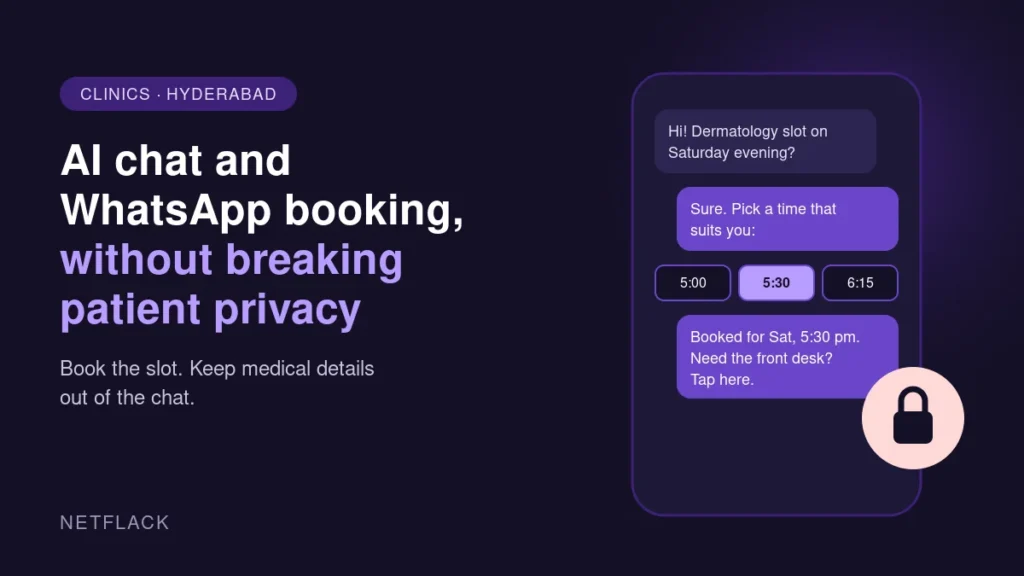
A sensible setup might look like this. When someone messages, the first reply is short: a greeting, one line saying the clinic uses their details only to manage appointments, and a link to the full privacy notice on the website. Then four buttons. Book a consultation, clinic timings and fees, reschedule, talk to the front desk.
If they choose to book, the bot asks for a name, shows the doctors’ available slots from the clinic’s calendar, and confirms. The evening before, the patient gets a reminder with a “reschedule” button. The “talk to the front desk” button is there in every message, not hidden after five steps. Staff log in to a shared inbox with their own accounts, so when the receptionist leaves the job, her access goes with her.
Nothing in that flow needs the patient’s skin condition. The doctor will hear all of that in the consultation room, where it belongs.
Where most clinics go wrong
The most common mistake we see isn’t the chatbot at all. It’s the old patient list.
A clinic has three years of phone numbers saved on the reception phone. Someone exports them, uploads them to a bulk messaging tool and sends “Free skin check-up camp this Sunday!” to everyone. Nobody on that list opted in to marketing messages. That breaks WhatsApp’s opt-in rule, it can get the number restricted, and once the DPDP duties apply it sits badly with the consent requirements too.
The second mistake is running patient chats on the receptionist’s personal WhatsApp. Prescriptions, phone numbers and conversations end up on a phone that goes home every night, gets lent to a nephew and is never wiped when she changes jobs. If you’re serious about privacy, the booking number should belong to the clinic, sit on the WhatsApp Business Platform or at least a clinic-owned device, and be accessed through staff logins.
Questions to ask before you pick a tool
Every vendor will show you a slick demo. Fine. Then ask them these:
- Does it run on the official WhatsApp Business Platform through an authorised provider, or on an unofficial workaround that could get your number blocked?
- Where is the chat data stored, and can you delete old conversations yourself?
- Is your patients’ chat data used to train their AI models? Get the answer in writing.
- Can each staff member have their own login, with access removed in one click?
- Is there a one-tap handover to a human, and what happens to chats outside clinic hours?
- Will they sign a contract that says how they process and protect your data?
Our honest take? If your clinic gets fewer than a couple of dozen booking requests a day, you probably don’t need AI at all. A simple button menu connected to a booking calendar does the job, costs less and has far fewer ways to go wrong. We’d add an AI layer only when patients are sending lots of free-text questions that the menu can’t handle, and even then we’d keep it on a short leash.
A quick check before you switch it on
Before the first patient sees it, run through this with whoever built the flow:
- The first message links to a privacy notice written in plain English, and ideally Telugu too.
- Marketing messages only go to people who ticked a separate opt-in, not to everyone who ever booked.
- The bot never asks for symptoms, reports, Aadhaar or payment card numbers.
- Medical questions get a fixed safe reply and a human handover.
- You know how a patient can ask you to delete their data, and who on the team handles that request.
Test it yourself from a family member’s phone. Try to break it. Ask it about medicines, type in Telugu, send a voice note, message at 2 am. You’ll learn more in twenty minutes than from any vendor demo.
The receptionist still matters
A booking bot is a tool for your front desk, not a replacement for it. Patients forgive a clinic for a slow reply. They don’t forgive one that sends their health details to the wrong place. Keep the bot narrow, keep consent clean and keep a human one tap away, and WhatsApp booking can make your clinic feel a lot easier to deal with.
If you’d like help setting up the marketing side of this, from ads that open WhatsApp chats to a Google Business Profile that sends patients your way, have a look at our digital marketing for hospitals and clinics in Hyderabad, our local SEO services and our lead generation work. Or just get in touch and tell us how your clinic books appointments today.
Topic: Digital Marketing
Related articles
 Digital Marketing
Real Estate Leads in Hyderabad and Vizag: Using AI to Qualify Meta Lead-Form Enquiries Faster
 Digital Marketing
Will AI Replace Your Digital Marketing Agency? What AI Can Do for a Small Business, and What Still Needs People
 Digital Marketing